
Executive Guide Overview
Avoid expensive paint shortages and wasteful over-ordering. This comprehensive master guide breaks down the exact mathematical formulas, substrate porosity factors, spreading rates across different finishes, primer requirements, and room-by-room calculations for Kenyan homes.
Key takeaways
- Calculate net area, coats, practical coverage, and wastage in that order.
- Use product-specific coverage rather than a universal square-metre rule.
- Keep ceilings, trim, repairs, and exterior textures in separate estimates.
Read this guide in sections
1. The Fundamental Physics of Paint Coverage & Spread Rates
Accurately estimating paint is one of the most critical stages of any building or renovation project in Kenya. Ordering too little paint halts site progress, increases transport costs from multiple trips to hardware depots, and risks noticeable batch-to-batch colour variation on exposed walls. Conversely, over-ordering ties up precious capital in expensive paint buckets that spoil in storage.
In professional coatings engineering, paint consumption is governed by Theoretical Spreading Rate (TSR) versus Practical Spreading Rate (PSR). Theoretical spreading rate is the area that a volume of paint can cover at a specified dry film thickness (DFT) on an impervious, perfectly smooth test surface. In the real world, Kenyan building substrates, from rough machine-cut quarry stone and porous sand-cement plaster to gypsum board and previously painted surfaces, exhibit significant texture, porosity, and absorption variations that lower practical coverage.
To compute the exact paint volume required for any domestic or commercial space, professional painters follow a disciplined sequence: calculating gross surface area, subtracting architectural cut-outs (doors, windows, archways), adjusting for substrate absorption profiles, applying the manufacturer's spreading rate, factoring the mandatory number of coats, and adding a controlled wastage allowance.
Never estimate paint by the number of bedrooms alone. A 3-bedroom maisonette with 3.2m high ceilings and large open-plan living areas can require over 65% more paint than a standard 3-bedroom bungalow with 2.6m ceilings.
2. The Mathematical Paint Calculation Formula
The standardized mathematical formula used by quantity surveyors and certified Yubla master contractors is structured as follows:
Let us dissect each variable in this equation with precision to understand how real-world site conditions influence your final tin count.
Working equation
Total paint volume = [(gross wall area minus openings) × number of coats ÷ practical spreading rate] × (1 + wastage factor)
| Measurement Variable | Standard Metric Unit | Typical Range in Kenyan Homes | Impact on Paint Volume |
|---|---|---|---|
| Gross Wall Area | Square Metres (m²) | 50 m² to 600+ m² | Primary baseline determining raw paint volume. |
| Door Cut-Out | Square Metres (m²) | 1.8 m² to 2.2 m² per door | Deducted from gross wall area to prevent over-buying. |
| Window Cut-Out | Square Metres (m²) | 1.2 m² to 3.5 m² per window | Deducted; larger French windows reduce wall paint needs. |
| Number of Coats | Integer count | 2 coats (standard) to 3 coats (new plaster) | Multiplies total volume linearly across the substrate. |
| Spreading Rate | m² per Litre per coat | 4 m²/L (Textured) to 14 m²/L (Gloss) | Determined by product viscosity, solids content & finish. |
| Wastage Allowance | Percentage (%) | 8% (interior roller) to 15% (exterior spray) | Compensates for roller absorption, edges, and touch-ups. |
3. Coverage Rates by Paint Finish & Substrate Texture
Different paint categories have radically different coverage profiles due to their formulation, binder chemistry, volume solids, and pigment volume concentration (PVC). Using the wrong spreading rate in your calculation will lead to substantial discrepancies.
For example, high-build exterior textured wallcoats like Yubla Tuff Tex Wallcoat are formulated with crushed silica aggregate and elastomeric acrylic polymers to bridge hairline shrinkage cracks and withstand equatorial UV degradation. Because they build a thick 150–250 micron barrier, they cover 4 to 6 m² per litre. In contrast, interior vinyl emulsions like Yubla Silk Sheen Vinyl or Supermatt Emulsion spread easily over primed plaster at 10 to 12 m² per litre per coat.
| Yubla Product & Finish | Ideal Substrate | Coverage (m²/L/Coat) | Recommended Coats | Standard Pack Sizes |
|---|---|---|---|---|
| Supermatt Emulsion (Matt) | Interior walls & ceilings | 10 – 12 m²/L | 2 coats | 4L Can, 20L Bucket |
| Trademat Trade Emulsion | High-volume rental interiors | 9 – 11 m²/L | 2 coats | 20L Bucket |
| Silk Sheen Vinyl (Silk) | Living rooms, corridors, kitchens | 10 – 12 m²/L | 2 coats | 4L Can, 20L Bucket |
| Tuff Tex Wallcoat (Textured) | Exterior facades, boundary walls | 4 – 6 m²/L | 2 coats | 20L Bucket |
| Super Gloss White (High Gloss) | Wood doors, fascia boards, metal trims | 12 – 14 m²/L | 2 coats | 1L Tin, 4L Can |
| SkimPro All Weather Plaster | Raw masonry skimcoat prep | 1.2 – 1.5 kg/m² | 1 to 2 skim passes | 25kg Bag |
4. Step-by-Step Practical Calculation Example: 3-Bedroom Maisonette in Nairobi
To demonstrate how this calculation works in practice, let us calculate the paint required for an actual Kenyan 3-bedroom residential home located in Syokimau, Machakos/Nairobi metro area. The property features:
Living and dining room: 8.5m length by 4.2m width by 2.8m ceiling height, containing two large sliding windows measuring 2.4m by 1.8m each and one front entrance door measuring 1.0m by 2.4m.
Master bedroom and two secondary bedrooms: combined wall perimeter of 52 metres with a 2.8m ceiling height, containing four standard windows measuring 1.5m by 1.5m and three interior flush doors measuring 0.9m by 2.1m.
Kitchen and corridors: combined wall perimeter of 28 metres with a 2.8m ceiling height, containing two windows and three open archways.
Let us compute the net paintable area:
6. Commercial Packaging Breakdown: To minimize cost, order two 20L buckets (40L) plus three 4L cans (12L) plus one 1L tin (1L) = 53 Litres total, perfectly fulfilling the project without waste.
- 1. Gross wall area(8.5 + 4.2 + 8.5 + 4.2) × 2.8 + (52 × 2.8) + (28 × 2.8) = 71.12 m² + 145.6 m² + 78.4 m² = 295.12 m²
- 2. Total openings to deduct[2 × (2.4 × 1.8)] + [1 × (1.0 × 2.4)] + [4 × (1.5 × 1.5)] + [3 × (0.9 × 2.1)] + [2 × (1.2 × 1.2)] = 8.64 + 2.4 + 9.0 + 5.67 + 2.88 = 28.59 m²
- 3. Net paintable area295.12 m² − 28.59 m² = 266.53 m²
- 4. Two coats of Yubla Silk Sheen Vinyl(266.53 m² × 2 coats) ÷ 11 m²/L = 533.06 ÷ 11 = 48.46 litres
- 5. Wastage and touch-up margin48.46 litres × 1.10 = 53.3 litres
Buying 20L buckets always yields a 15% to 22% lower cost per litre compared to multiple 4L cans. Always optimize your order around 20-litre master containers for main walls.
5. Calculating Exterior Facade & Boundary Wall Paint
Exterior estimations differ fundamentally from interiors because exterior elevations feature complex architectural geometries including gables, eave soffits, balconies, pillars, and boundary perimeter walls.
For perimeter boundary walls built from natural machine-cut stone (Ndunyu or Thika stone) with flush cement pointing, the initial coat absorbs up to 30% more paint than smooth plastered brick. When painting unplastered perimeter stone walls with weather-shield coatings, reduce your spreading rate estimate from 5 m²/L down to 3.5 m²/L for the first coat, followed by 5 m²/L for the second coat.
For multistory houses, measure each elevation independently: North, South, East, and West. The East and West elevations in Kenya experience extreme morning and afternoon sun angles, requiring heavy weather-shield acrylic coatings such as Yubla Tuff Tex Wallcoat to ensure zero pigment degradation over 7+ years of exposure.
6. Primer & Undercoat Calculation Rules
One of the costliest mistakes homeowners make is skipping the primer calculation. When applying topcoat paint directly over raw cement plaster, fresh skimcoat, or repaired wall patches, the porous plaster sucks the binder out of the paint in a phenomenon known as 'suction flash'. This leaves the pigment unsupported on the surface, causing chalking, patchy sheen, and premature peeling.
How to calculate primer quantities:
Fresh plaster, cured for at least 28 days: one full saturation coat of penetrating alkali-resistant masonry primer at 8 to 10 square metres per litre.
Skimmed gypsum boards: one coat of gypsum primer or sealer at 11 to 13 square metres per litre.
Repainting dark walls in light colours: one high-opacity white undercoat to block colour bleed, reducing topcoat coats from four coats to two coats.
7. Using the Yubla AI Visualizer to Validate Your Paint Schedule
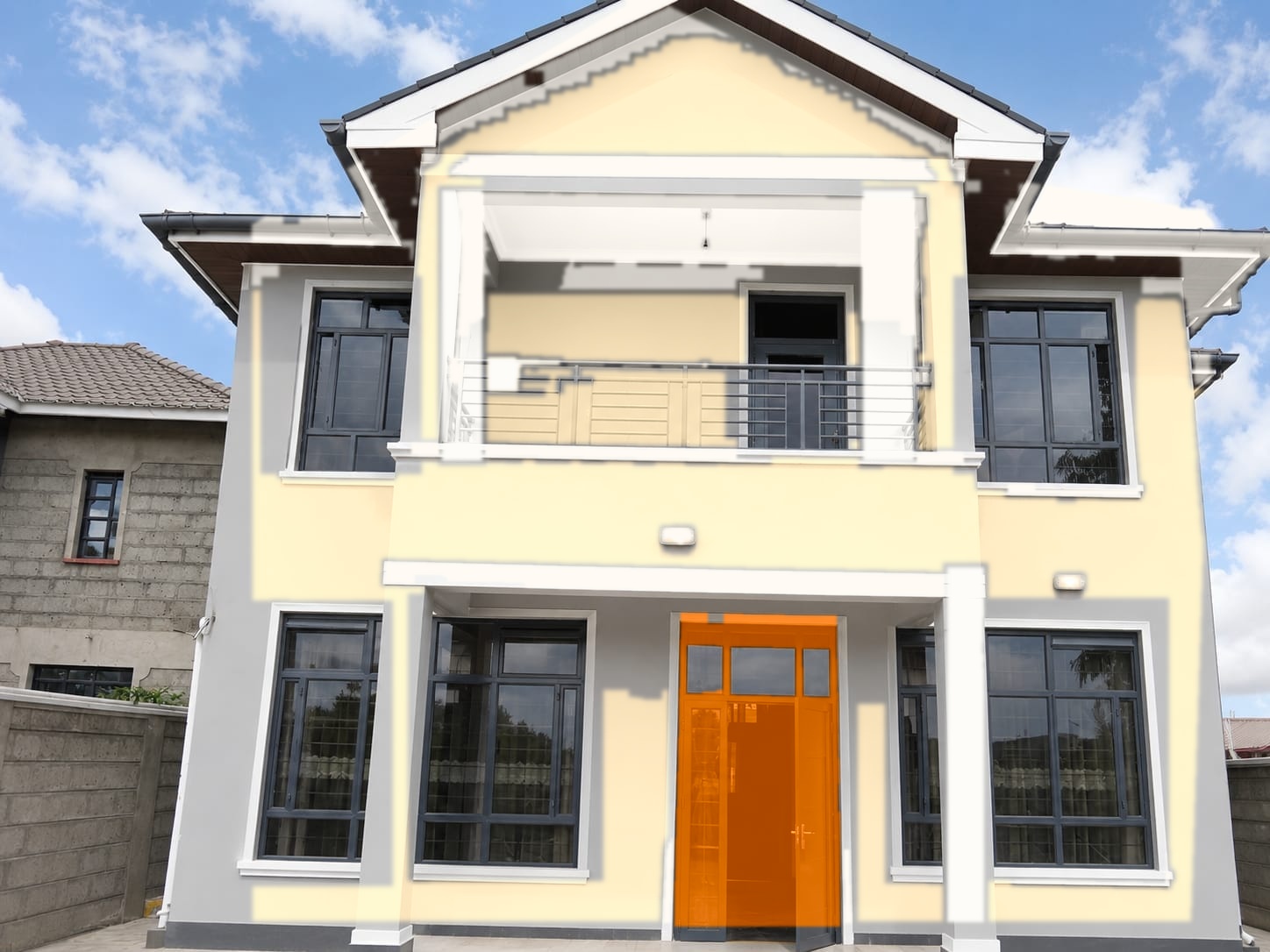
Before purchasing paint buckets, professional contractors use the Yubla AI House Visualizer to visually segment each architectural surface (Main Walls, Columns, Trim, Fascia, Doors, and Roof) and confirm the exact square meterage and litre schedule.
Uploading your home photograph into the Yubla Visualizer automatically calculates the surface area of each detected mask and correlates the selected colour family with recommended Yubla product SKUs and litre packaging options.
8. A Room-by-Room Measurement Worksheet You Can Use on Site
Measure first, calculate second, and write down assumptions
A useful estimate starts with a simple worksheet rather than a guess based on the number of bedrooms. For every room, record the length, width, wall height, number and size of doors, number and size of windows, and whether the ceiling is included. Measure in metres and keep two decimal places. If a room is not rectangular, split it into rectangles and add the areas. For a staircase, measure each visible wall plane separately; do not multiply the floor area by a generic factor.
Example: a 4.2m by 3.6m bedroom with a 2.7m height has a perimeter of 15.6m and a gross wall area of 42.12m². A 0.9m by 2.1m door removes 1.89m² and a 1.5m by 1.2m window removes 1.8m², leaving 38.43m². At 10m² per litre per coat, two coats require 7.69 litres before wastage. A practical order is 8 litres, or the nearest combination of available packs that leaves a labelled touch-up reserve.
Do not deduct every opening when its reveal, sill, or frame will also be painted. Conversely, do not count a large built-in wardrobe as an opening if the wall behind it will eventually be exposed. Note surfaces separately: ceiling paint, wall emulsion, enamel on timber, and textured exterior coating should never be combined in one calculation because their rates and preparation differ.
Before placing a bulk order, compare your worksheet with the product data sheet and ask the painter to confirm the assumed spreading rate. Coverage printed on a bucket is normally a best-case figure on a smooth, sealed surface. A roller with a long nap, rough plaster, strong wind, or a porous repaired patch will consume more. The worksheet gives you an auditable estimate; the test patch and first coat tell you whether the assumption is realistic.
9. Ordering, Storing, and Mixing Paint Without Costly Mistakes
Buy the main wall colour in one order wherever possible. Even when a colour name and code are identical, separate tinting batches can vary slightly. For a large elevation, box or intermix containers from the same batch rather than finishing one bucket before opening another. This is especially important on long boundary walls, where a subtle change can show as a vertical band in afternoon light.
Choose pack sizes by use, not just by sticker price. Large buckets are normally efficient for uninterrupted walls; smaller cans are useful for bedrooms, feature walls, trim, and the final touch-up reserve. Keep the invoice, colour code, batch number, and leftover quantity. Seal opened paint tightly, wipe the rim clean, store it upright in a cool dry room away from direct sun, and never leave a water-diluted mixture for later use.
Plan the delivery date around preparation and weather. Paint should not arrive weeks before the site is ready, particularly where storage is hot or damp. On an exterior project, have a covered place ready and confirm that the wall will remain dry for the product's recoat and curing window. A short site visit by a verified painter can prevent a larger error than trying to save one delivery charge.
Keep a small amount of the original batch for later nail holes, plumbing work, and accidental scuffs. A perfect calculation with no touch-up reserve is still an incomplete maintenance plan.
10. Estimating Ceilings, Trim, Doors, and Feature Walls
Walls are only one part of a paint schedule. Ceilings are calculated from floor area, but a sloped ceiling, bulkhead, or open stairwell needs its own measurements. A 4m by 5m flat ceiling is 20m²; two coats at 10m² per litre require 4 litres before wastage and primer. A ceiling with a visible water stain needs diagnosis and stain isolation first, otherwise the mark can bleed through a fresh white coat. Include the underside of beams and the faces of bulkheads rather than assuming they are part of the ceiling rectangle.
For doors, measure both faces if both will be painted, then add the edges and frames. A standard 0.9m by 2.1m door is 1.89m² per face, but six-panel doors have more surface and absorb more product around their mouldings. Timber requires cleaning, sanding, knot and stain treatment, and the correct undercoat before enamel. Metal security grilles are time-consuming even when their calculated area is small, so allow for spray loss or brush working and ask the painter to price labour separately from litres.
Feature walls deserve a separate line item because a saturated colour often needs a well-sealed, uniform base and careful cutting-in. If the new colour is much darker than the existing wall, the first coat may look uneven even when application is correct. A tinted undercoat can reduce the number of topcoats, but only use one when the product system permits it. Keep the feature colour in its own labelled container and do not calculate it as though it were mixed into the main wall order.
For a practical project budget, make four columns: paintable area, coats, litres, and pack choice. Add preparation materials such as filler, sandpaper, primer, masking tape, roller sleeves, drop sheets, and cleaning supplies. The litre figure answers a coverage question; it does not represent the full cost of delivering a neat finish. Sharing this worksheet with a contractor makes quotations easier to compare and exposes missing preparation before work starts.
11. How to Reconcile Your Estimate With a Painter's Site Quote
A contractor may quote a different quantity from your worksheet for legitimate reasons. They may include the roughness of a boundary wall, a third coat over a dark colour, the reveals around windows, or a primer that your first calculation omitted. Ask them to explain the difference by surface rather than accepting a single unexplained total. A useful quote names the product, finish, pack size, estimated litres, coats, repair allowance, and whether unused sealed material remains with the homeowner.
Agree what happens if the first coat reveals unexpected suction, stains, or repairs. The painter should stop and discuss a change rather than silently dilute the topcoat or spread it too thin. Record any revised measurement and keep receipts for additional material. This protects both sides: the owner understands why the budget changed and the contractor is not forced to absorb a genuine substrate problem.
After completion, walk each room in daylight and check coverage from normal viewing distance. Look for holidays, lap marks, flashing, and unpainted edges. Do not judge a colour while the film is still wet. Confirm that leftover paint is sealed and labelled, and store the final schedule with photographs of the colour codes. A professional estimate is not merely a number of buckets; it is a repeatable record of what was applied, where, and why.
12. Final Paint Quantity Checklist
Before you pay for the order, confirm the net areas, coats, product coverage, primer, trim, wastage, pack sizes, batch details, and a touch-up reserve. This final check takes less time than returning to a distant hardware shop after a painter has started. It also gives everyone the same practical plan for a clean, predictable finish.
When you are ready to plan the work, use the Yubla colour visualizer to preview the finish on your own home, browse the Yubla paint catalogue for the right product, and connect with a verified painter through our professional painting services.
Frequently Asked Questions
How many 20-litre buckets do I need for a standard 3-bedroom house in Kenya?
A standard 3-bedroom bungalow (approx. 250–300 m² wall area) typically requires three 20L buckets (60L) of interior wall emulsion for two full coats, plus one 20L bucket of ceiling paint and one 4L gloss can for doors/trims. For exterior walls, plan for two to three 20L buckets of Tuff Tex depending on house height and boundary wall perimeter.
How much paint does a 20-litre bucket cover in Kenya?
A 20-litre bucket of Yubla Supermatt or Silk Vinyl emulsion covers approximately 200 to 240 square metres per single coat, or 100 to 120 square metres with the recommended two coats. For heavy textured exterior coatings like Tuff Tex, a 20L bucket covers 80 to 100 square metres single coat (40–50 m² in two coats).
Why should I add 10% to my paint estimate?
The 10% wastage allowance compensates for roller absorption, roller tray residue, cutting-in along ceilings and baseboards, minor surface porosity variations, and retaining a sealed touch-up jar from the same manufacturing tint batch for future repairs.
Can I dilute paint with water to make it cover more area?
No. Paint should only be thinned according to technical data sheet instructions (maximum 5–10% clean water for the first mist coat over porous plaster). Over-diluting paint breaks down the acrylic polymer resin, ruining durability, washability, and colour opacity.
Ready to Start Your Painting Project?
Preview authentic Yubla colours on your building or hire verified local painters today.